Platform overview

Personalized Messaging

Write from evidence. Sound like yourself.

Bring selected context, company positioning, and saved writing-style guidance into one draft. You review the reason, claims, recipient, wording, and next action before deciding whether and how to send.

Selected context

Choose what the draft can use

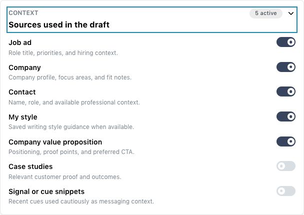
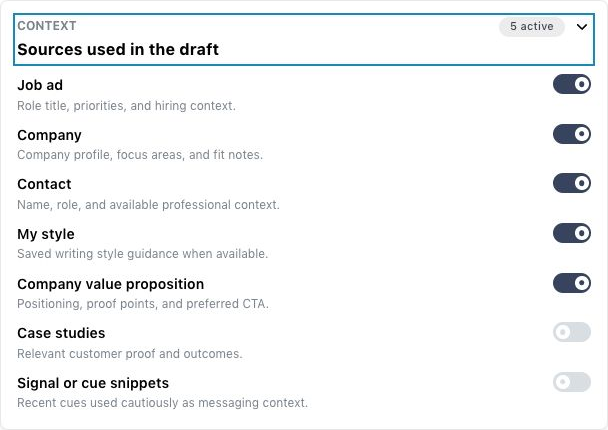
The current composer exposes source controls for job-ad context, company information, contact context, saved writing-style guidance, company positioning, case studies, and Signal or cue snippets. Availability can vary, and the seller decides which supported context belongs in the draft.

Selection does not change authority. Evidence remains evidence, analysis remains interpretation, and an Actionable Signal remains a separately gated recommendation.

Dark Queast message composer source controls showing job ad, company, contact, saved writing style, company value proposition, case studies, and Signal or cue snippets as separately selectable inputs
Current product evidence: individual source families can be selected for a draft. The example state does not imply a default or universal workspace configuration.

Clear authority

Keep each decision visible

A draft can use supported context without turning its own wording into evidence. Each stage keeps a different job and owner.

  1. 01

    Selected evidence

    Choose relevant account, person, opportunity, relationship, and positioning context.

  2. 02

    Analysis or recommendation

    Keep interpretation and any eligibility-gated Actionable Signal separate from the draft.

  3. 03

    Draft

    Apply the chosen scenario, template, language, channel, length, instruction, and style guidance.

  4. 04

    Seller review

    Check the recipient, reason, claims, wording, and ask; then edit, regenerate, copy, or save.

  5. 05

    Seller-chosen sending

    The seller decides whether, when, where, and how to send. Queast does not send autonomously.

Personal writing style

Use your voice as guidance—not a new persona

Saved style guidance can shape the structure and phrasing of a first draft. It cannot make unsupported context true or remove the need for review.

Shape the delivery

Use saved guidance for pacing, sentence shape, warmth, directness, and the call to action.

Keep positioning consistent

Combine the seller’s style with selected workspace positioning and a suitable template.

Protect the boundary

Do not quote private examples, manufacture familiarity, or create an artificial persona.

Keep the seller responsible

The seller checks that the final wording is accurate, appropriate, and ready to carry their name.

Anonymized dark Queast message composer showing a draft area, scenario and template choices, language, channel and length settings, plus regenerate, save, copy and Gmail action controls
Current product evidence: the seller can inspect a draft alongside scenario and draft settings, then choose a visible review action. Recipient and message contents are anonymized.

Draft controls

Match the draft to the situation

The current composer shows scenario, template, channel, language, length, recipient, and review actions together. The example message and recipient are anonymized here; visible controls prove the interface, not that every option is available in every workspace.

  • Scenario and template
  • Channel, language, and length
  • Recipient and context
  • Regenerate, save, and copy
  • Seller-chosen Gmail action

Human-controlled drafting

Review every draft before it leaves your control

Queast supports preparation and writing. The seller remains responsible for the interpretation, claims, approval, channel, timing, and sending action.

  1. 01

    Reason

    Confirm that the outreach angle is supported by the selected evidence.

  2. 02

    Authority

    Keep observations, analysis, recommendations, and draft wording at the right level.

  3. 03

    Recipient

    Do not turn company context into claims about an individual.

  4. 04

    Voice and claims

    Check the wording, capability statements, proof points, and outcome claims.

  5. 05

    Next action

    Choose deliberately whether, when, where, and how to proceed.

Next step

Start closer to a message you can defend

Talk to us about human-controlled drafting, or see how Workbench carries a reviewed next step into the seller’s daily queue.