Analysis and recommendations

Actionable Signals

A Signal should mean more than one interesting event

Queast recommends action only when a time-aware Composite Intent is active and the applicable evidence, freshness, conflict, customer-capability, deduplication, and eligibility checks support it.

Strict authority path

Earn the recommendation in stages

No job ad, post, tag, trait change, or other single observation creates an Actionable Signal. Each layer has a distinct job and preserves its evidence.

  1. 01

    Source evidence

    Dated observations remain traceable to the company, source, and context that produced them.

  2. 02

    Evidence-backed proposals

    Execution Signals and Context Modifiers organize possible meaning without becoming a recommendation.

  3. 03

    Composite Intent

    Related evidence contributes across time to an emerging, active, cooling, dormant, or suppressed company hypothesis.

  4. 04

    Eligibility contract

    Only an active intent can pass the applicable confidence, freshness, conflict, capability, dedupe, and evidence checks.

  5. 05

    Actionable Signal

    The eligible output presents a practical next step with its supporting basis available for review.

Product evidence

Review readiness and contract context before acting

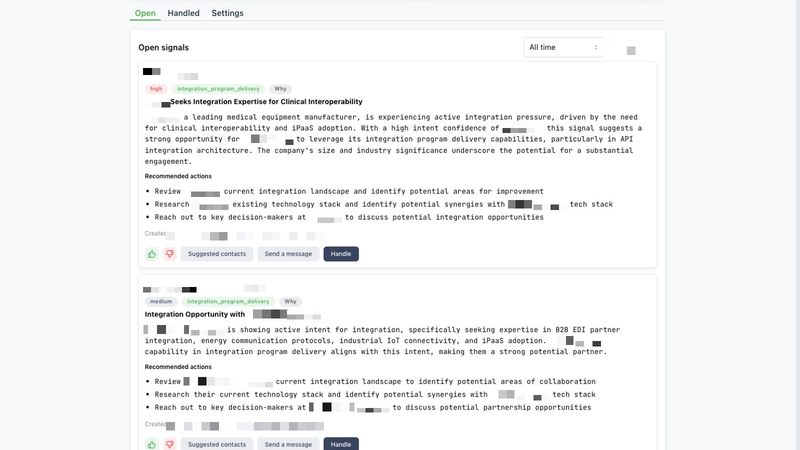
The current Smart Signals view exposes a capability-readiness prompt, strict contract label, evidence-cue count, rationale control, and open or handled state. These visible controls make the recommendation reviewable; they do not independently validate the example company, score, or generated prose.

  • Capability readiness
  • Strict contract label
  • Evidence-cue count
  • Rationale and handling state
Wide dark Queast Smart Signals view showing the tutorial, capability readiness prompt, open and handled tabs, strict contract label, cue count, and rationale control
Product evidence: the interface exposes readiness and strict contract context. The example company, fit score, and generated prose are not presented as independently verified claims.

Strict eligibility

Pass every applicable gate

Strict eligibility is conjunctive: a missing or failed required check holds the recommendation back. Technology labels and broad fit context cannot substitute for any gate.

  1. 01

    Active intent

    The relevant time-aware Composite Intent must be active.

  2. 02

    Confidence

    Confidence must meet the configured contract threshold.

  3. 03

    Freshness

    The supporting evidence must still be current enough to act on.

  4. 04

    No hard conflict

    A suppressing conflict prevents a strict Actionable Signal.

  5. 05

    Capability truth

    Required customer capability truth must be explicit and policy-satisfied.

  6. 06

    Stable dedupe

    A stable key prevents the same recommendation from multiplying.

  7. 07

    Evidence references

    Deterministic supporting references remain attached for audit and review.

Strict means AND. Every applicable gate must support action.

Inspectable recommendation

See what supports the next step

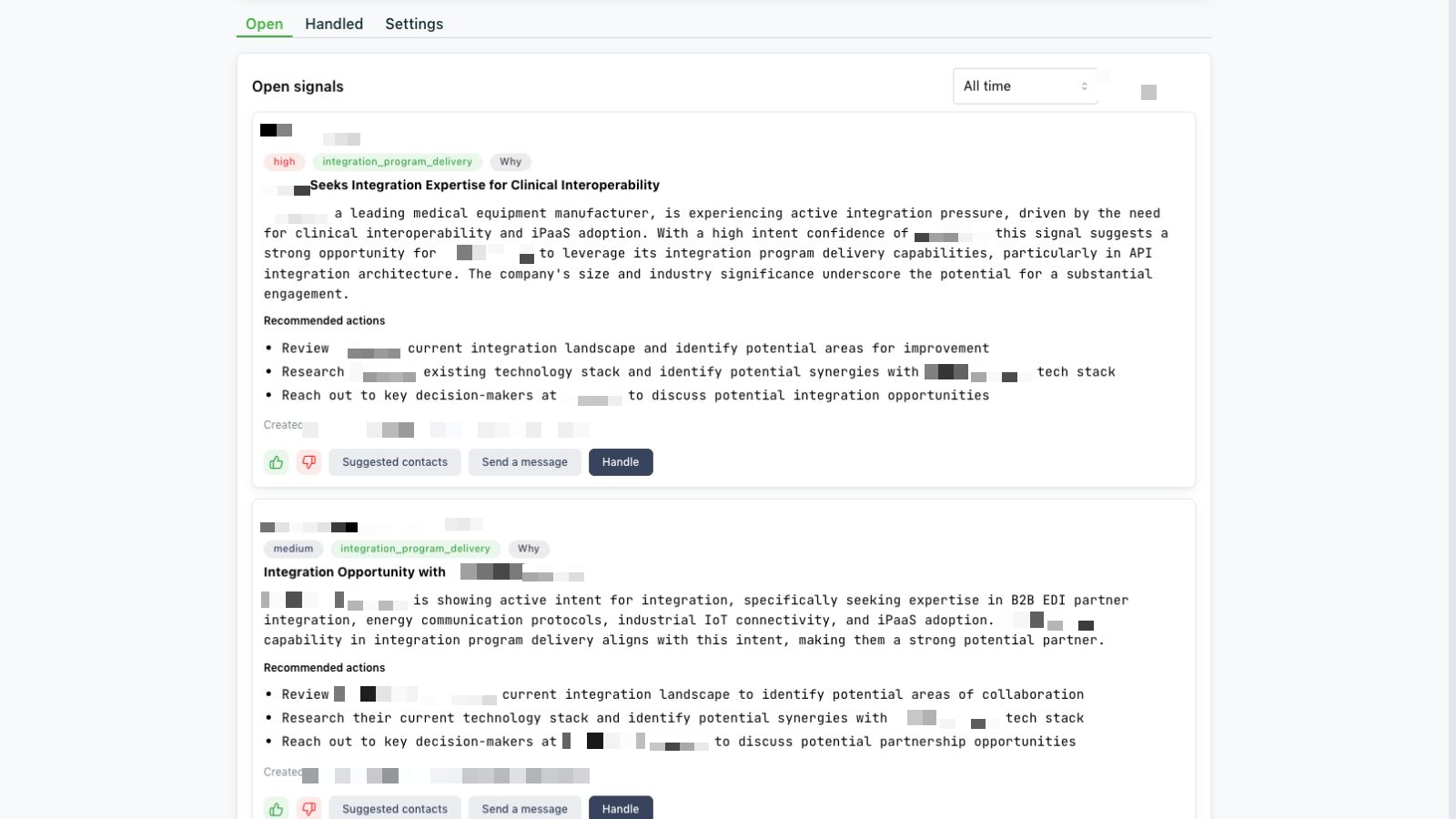
An Actionable Signal brings the recommendation and its boundaries together so the seller can decide whether it fits the current account strategy.

Why now

The active Composite Intent and timing behind the recommendation.

Evidence trail

The supporting observations, dates, and references that can be inspected.

Capability and contract

The customer-specific capability truth, applicable mode, and any remaining caveat.

Next action

A practical suggestion the seller can inspect, handle, dismiss, or carry into preparation.

Honest non-actions

Keep blocked and lower-authority states visible

Research context remains useful even when the strict contract does not support action. Queast keeps those states explicit instead of silently promoting them into Signals.

Hold

Insufficient or stale

Keep the item at research level and expose the missing or outdated context.

Suppressed

Suppressed

Retain the hypothesis and hard conflict for audit; do not produce a Signal.

Unknown

Capability unknown

Hold the strict recommendation according to policy; never infer customer capability truth.

Mode label

Informational or legacy

Label the contract mode and do not present it as equivalent to a strict Actionable Signal.

Seller-controlled workflow

Move from recommendation to human action

Queast supports preparation and drafting while the seller controls interpretation, qualification, wording, and the next action.

Next step

See one evidence-backed recommendation

Claim a free Signal to review the path from supporting evidence to a practical next step, or explore the analysis layer behind it.