Queast remains the product
The Platform keeps market evidence, analysis, recommendations, reviewable drafts, and daily workflow connected. GrowthOS is not a separate data source or recommendation engine.
Explore the PlatformOptional managed GTM support
GrowthOS is optional managed support for IT-services teams that want help configuring and operating a Queast-powered GTM motion. Queast remains the software product, and teams can adopt it directly. The exact scope, access, responsibilities, channels, approval gates, handover, reporting, timing, and commercial terms must be agreed before work begins.
Optional by design
GrowthOS adds an agreed operating layer around Queast. It does not replace the product, create a required service path, or take decision authority away from the customer.
The Platform keeps market evidence, analysis, recommendations, reviewable drafts, and daily workflow connected. GrowthOS is not a separate data source or recommendation engine.
Explore the PlatformThe category is for teams that want help maintaining an agreed evidence-to-action rhythm. The name does not define a universal delivery package.
The customer approves scope, operating rules, claims, messages, channels, handover, and commercial action. Support stays inside the agreed contract.
Compare service choicesPotential operating areas
These areas can shape an engagement discussion. They are not claims that every GrowthOS engagement includes the same work.
Define approved customer capabilities, targeting rules, disqualifiers, reviewers, and working rhythm.
Review supported company and person context under agreed market, privacy, identity, and access rules.
Prepare evidence-aware drafts under approved claims and writing constraints. Drafting does not authorize sending.
Define whether any channel operation or response handover belongs in scope, who may act, and where the customer takes ownership.
Agree what operating evidence is reviewed, who interprets it, and how any change is approved.
Platform product evidence
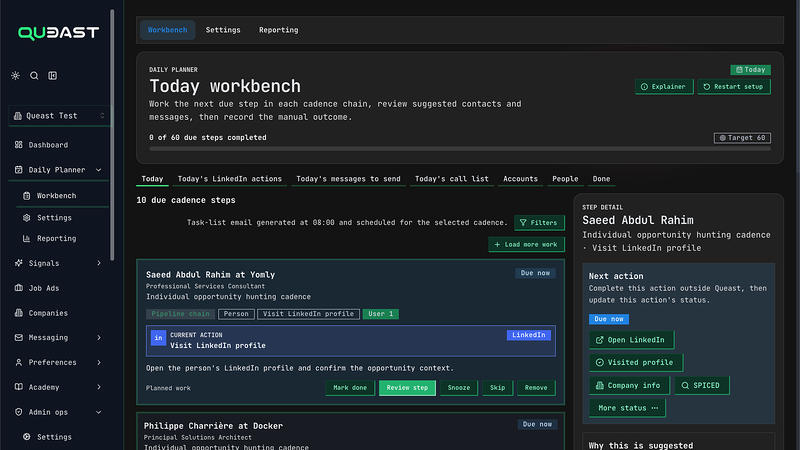
The current Workbench shows due cadence steps, suggested contacts and messages for review, and manual outcome recording. It proves the product workflow—not a GrowthOS delivery package, service outcome, or autonomous send path.
Suggested context and drafts remain available for a person to inspect.
The visible workflow asks the user to complete the action outside Queast and record the result.
An engagement contract must define whether and how an operator participates in this rhythm.
Fit check
GrowthOS should be considered for the operating need it may support, not as a prerequisite, default next service, or substitute for customer ownership.
The team can support responsible commercial activity with truthful claims and capacity for potential work.
Someone can review decisions and drafts, receive handovers, and own customer-side follow-through.
The team wants help running an agreed motion around Queast rather than replacing human judgment.
A team with a clear internal owner and operating rhythm may not need GrowthOS.
The service may not fit when offer, proof, delivery capacity, target decision, or customer ownership is unresolved.
No volume, meetings, pipeline, revenue, qualification, compliance, or deliverability result is promised.
Pre-engagement checklist
These questions keep a managed-support category from becoming an unsupported promise about access, delivery, control, timing, terms, or outcomes.
Which markets, offers, operating areas, and success questions belong in the engagement?
Which capabilities, targeting rules, disqualifiers, integrations, and operating settings are approved?
Which records, systems, accounts, people, and fields may be accessed—and how?
Which confidentiality, retention, deletion, identity, market, and data-protection rules apply?
Which messages, channels, sending paths, and external actions are permitted, reviewed, and approved?
Who approves targeting, claims, changes, and handovers—and where does customer ownership begin?
Which outputs, review format, measures, responsibilities, dependencies, and acceptance conditions apply?
Which availability, support, price, payment, setup, term, cancellation, transition, and exit rules apply?
Next step
Talk to Queast about the operating gap your team is trying to solve. The next step is to verify fit and define a bounded contract.