

Entry points
Research · prioritize · prepare · operate
 LoginClaim Your Free Signal
Decision map
Start with the immediate decision. Each path links to the narrowest relevant product page and keeps its evidence and authority boundary visible.
Inspect visible job-market and company evidence. A vacancy or technology mention remains evidence, not proof of a purchase or intent.
Open this pathUse supported evidence, time-aware analysis, capability truth, conflicts, and eligibility to decide which recommendations deserve inspection.
Open this pathPrepare questions, talking points, cautions, and a reviewable draft without inventing personal pain or permission to send.
Open this pathBring current context and preparation into a daily queue. A seller chooses the action, performs it, and records the outcome.
Open this pathResearch jobs
Research can organize supported evidence for a human decision. It cannot turn a source observation into a buying event or a claim about a person.
Review roles, skills, locations, descriptions, and technology labels across supported job-market evidence. Technologies remain qualifiers only.
ExploreBring supported company profile, activity, hiring, news, technologies, people, and history into one research path while keeping company and person claims distinct.
ExplorePrioritization jobs
A recommendation can focus research only after the applicable eligibility contract passes. Review remains distinct from opportunity creation or expansion demand.
Inspect the evidence and reasoning behind an eligible recommendation, confirm capability truth and targeting rules, and decide whether deeper research is warranted.
ExploreUse dated company evidence and time-aware analysis to reconsider a customer or strategic account. New activity does not by itself authorize outreach.
ExplorePreparation jobs
Preparation organizes supported context for human review. It does not complete discovery, infer personal intent, approve a claim, or send a message.
Organize available account evidence into SPICED preparation, visible gaps, and questions to test. This is not a qualification verdict or completed discovery.
ExploreUse supported person context for talking points and watch-outs without turning company activity into personal pain, authority, urgency, or intent.
ExploreUse selected evidence, approved claims, and personal writing controls to prepare a draft. A person reviews, edits, approves, and decides whether and how to send.
ExploreOperating jobs
Planned work and transport stay separate from performed work and customer decisions.
Review the planned action, account and person context, preparation, and cadence. The seller performs the external action and records the result.
ExploreUse a verified connection contract to transport an already-authorized artifact. Availability, direction, fields, events, permissions, and delivery behavior remain connection-specific.
ExploreProduct proof
The current Workbench target-review view shows company-first candidates, visible company context, stakeholder controls, and deliberate selection actions. It proves a review step—not universal coverage, an opportunity outcome, or autonomous execution.
Explore Daily Workbench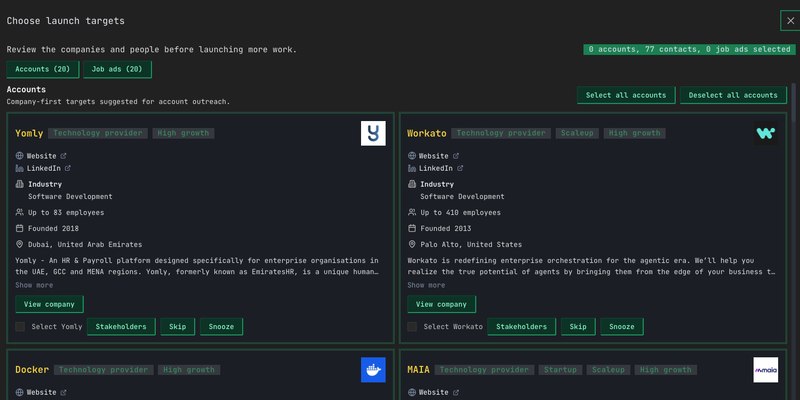
Optional support
Queast is the product. Teams can adopt and operate it directly. The two public services remain optional add-ons and cannot change product authority.
Compare optional servicesDiscuss an evidence-bounded operating baseline when the immediate constraint is still unclear. Exact scope and terms require a separate engagement contract.
Review the scopeDiscuss optional operating support when the customer can retain review and sales ownership. Exact scope, access, responsibilities, deliverables, timing, terms, and outcomes remain engagement-specific.
Review the scopeNext step
Review the source, date, account context, and uncertainty. Then decide whether the proposed next step deserves action.


